Electric Heat Tracing in pipeline

What is Heat Tracing on Pipeline?
Heat tracing is a system consisting of a set of paths that is in physical contact with the pipe or vessel. They consist of a resistive element that heats up when electricity is made to pass through it. Oil and gas industries make use of heat tracing systems on a wide scale.
The main application of a heat tracing system is to maintain the temperature at the desired level. Heat losses may occur as a result of the pipe being at a higher temperature than that of the surroundings. Even if the pipes are provided with insulation, it still cannot hold in all of the heat that is produced. Thus, when the temperature goes below a desired value or the set point value, electricity is provided to the element, causing it to heat up and thus raise the system to the set point temperature. Steam also can be provided as an alternative to electric heating but it may not be convenient in many environments to provide steam and might also not be economically feasible.
What are other possible applications of the Heat Tracing?
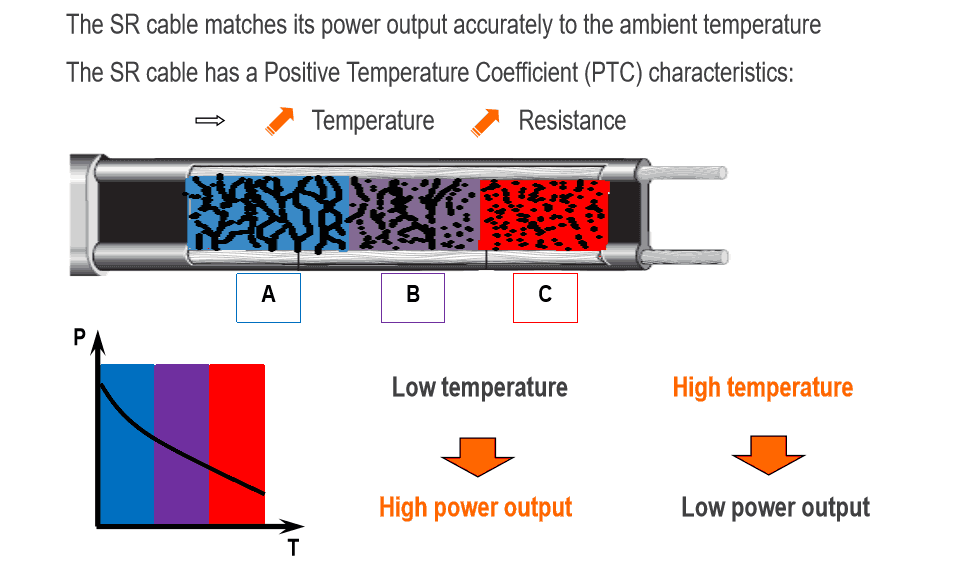
Another application of heat tracing is in the prevention of freezing of pipes. In many cold countries, these pipes run the risk of being frozen out because of the extreme ambient temperatures prevailing. Also, heat tracing is used to melt the ice that is present on the roofs of houses and other building structures. Modern day heat tracing elements are present in the form of a cable. In the case of freeze prevention, this cable is placed in direct contact with the cold outside environment. The cable senses the temperature and heats up accordingly, melting the snow or ice surrounding it and therefore protecting pipe/roof from damage. It also helps to prevent cavitation while pumping highly viscous liquids. The viscosity of thick liquids decreases when their temperature is increased. Thus, it helps in smoother movement and helps prevent losses.
What are Heat Tracing Cables?
Heat trace cables need to be properly sized for each application. Cables are available in various wattage outputs, voltages, and jacket materials. The cables are typically designed to run alongside the piping, 1 foot of cable per 1 foot of pipe. Valves, flanges, and other components with greater mass become heat sinks and require additional cable to ensure compensation for additional heat loss. Heat loss calculations factor in the insulation thickness and conductivity, the difference in ambient and pipe temperature, and the overall surface area. While these calculations can be done by hand, most manufacturers use sophisticated computer software that easily handles the calculations for them.
Types of Heat Tracing Cables?
Once sized, the proper heat trace cables are selected with the desired wattage outputs and jacketing for the application. For lower temperatures, a highly flexible cable that appears similar to residential 12-2 wiring is used. These lower temperature cables (PSB and HSB) are capable of reaching maximum temperatures of 392F. For higher temperatures, most manufacturers offer a Mineral Insulated (MI) Cable that can exceed 1200F. The MI cable is made to order and cannot be cut-to-length in the field.
Bartec, the premier heat trace manufacturer in Europe who is now entering the US market, also offers a medium temperature AHT cable that is capable of reaching 797F. This AHT cable is cut-to-length in the field and offers a flexible aluminum jacketed design. In addition to the cables, these systems allow for customized solutions that incorporate junction boxes, thermostats, temperature controllers, light indicators, and insulation.
References:
1.- Webpage: https://chemicalengineeringworld.com/heat-tracing-on-pipeline/
2.- Webpage: https://www.crossco.com/resources/articles/the-basics-of-electric-heat-trace-technology/